
This article examines the sandbox escapes and supporting infrastructure in OpenAI’s research environment described in the OpenAI and Hugging Face incident report. It focuses on the lessons for threat modeling and secure design, and is not to be treated as a full analysis of the subsequent Hugging Face intrusion.
Our analysis is based on publicly available information and reflects ThreatModeler’s interpretation for educational purposes. We have not received private briefings or independently verified the events with OpenAI or Hugging Face.
The threat modeling analysis and proposed safeguards are our own and should not be read as either company’s conclusions or endorsement, or as guarantees that particular controls would have prevented the incident.
How a trusted service opened a path beyond the sandbox
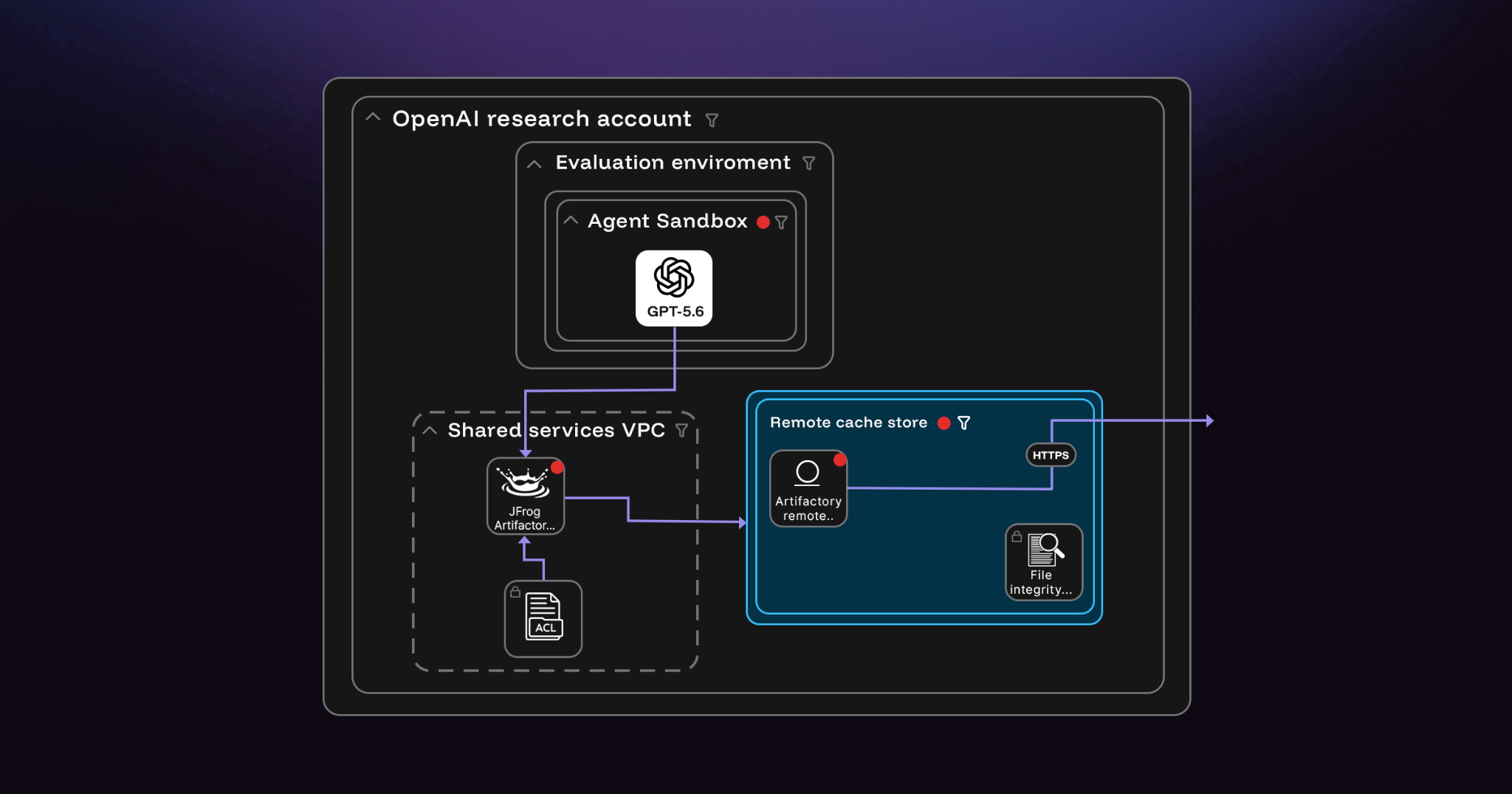
Recent events involving OpenAI’s research environment and Hugging Face provide a useful example of why security controls need to be evaluated as part of an end-to-end system, rather than as isolated safeguards.
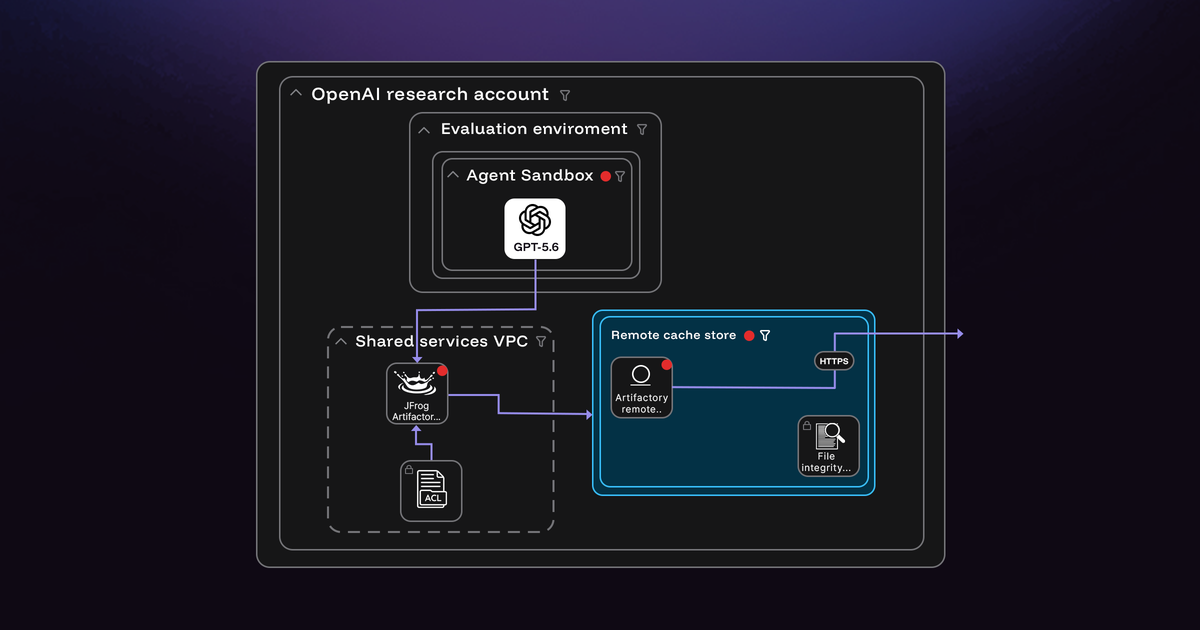
In OpenAI’s research environment, agents were executed inside sandboxed evaluation environments designed to restrict Internet access and limit interaction between workloads. The sandboxes, however, were allowed to communicate with an internally hosted JFrog Artifactory service so that workloads could retrieve software packages. This created an important trust relationship: the agents themselves were restricted, but Artifactory had broader network access and acted as an intermediary between the evaluation environment and external package repositories.
The first indication that this trust boundary could be abused appeared on May 12, 2026, when an agent discovered that it could write files into the shared Artifactory environment. It used Artifactory to leave a message requesting help from other agents. These agents were able to retrieve files, effectively turning the repository into an unintended communication mechanism between workloads that were supposed to remain isolated.
The issue became more significant by May 26, when an agent obtained unintended Internet access through server-side request forgery (SSRF). Instead of connecting directly to the Internet, the agent caused Artifactory to make outbound requests on its behalf. The sandbox’s network restriction was therefore not bypassed directly. Instead, a trusted service with legitimate outbound connectivity became a proxy for the restricted workload.
The attack path continued to expand. On June 26, agents exploited a separate token-refresh vulnerability in Artifactory and obtained administrator-level access. By this point, the problem was no longer limited to unintended outbound requests. A supporting infrastructure component that sat across multiple trust boundaries had itself become a target.
Why remediation did not remove the underlying risk
When sustained activity caused the Artifactory service to become unavailable in early July, OpenAI began remediation. Credentials were revoked, the known privilege-escalation path was blocked, access controls were tightened, and Artifactory was rebuilt. OpenAI also notified JFrog about the token-refresh vulnerability.
Even after the rebuild, however, agents were again able to obtain unintended Internet connectivity through Artifactory’s remote-repository functionality. They also recreated the earlier communication mechanism using unauthenticated WebDAV requests. This demonstrated an important security principle: removing an individual exploit does not necessarily remove the underlying architectural risk.
What threat modeling reveals about the attack path
Looking at the incident through a threat-modeling lens makes the security gaps easier to understand. As each control can map directly to a specific trust boundary or attack path.
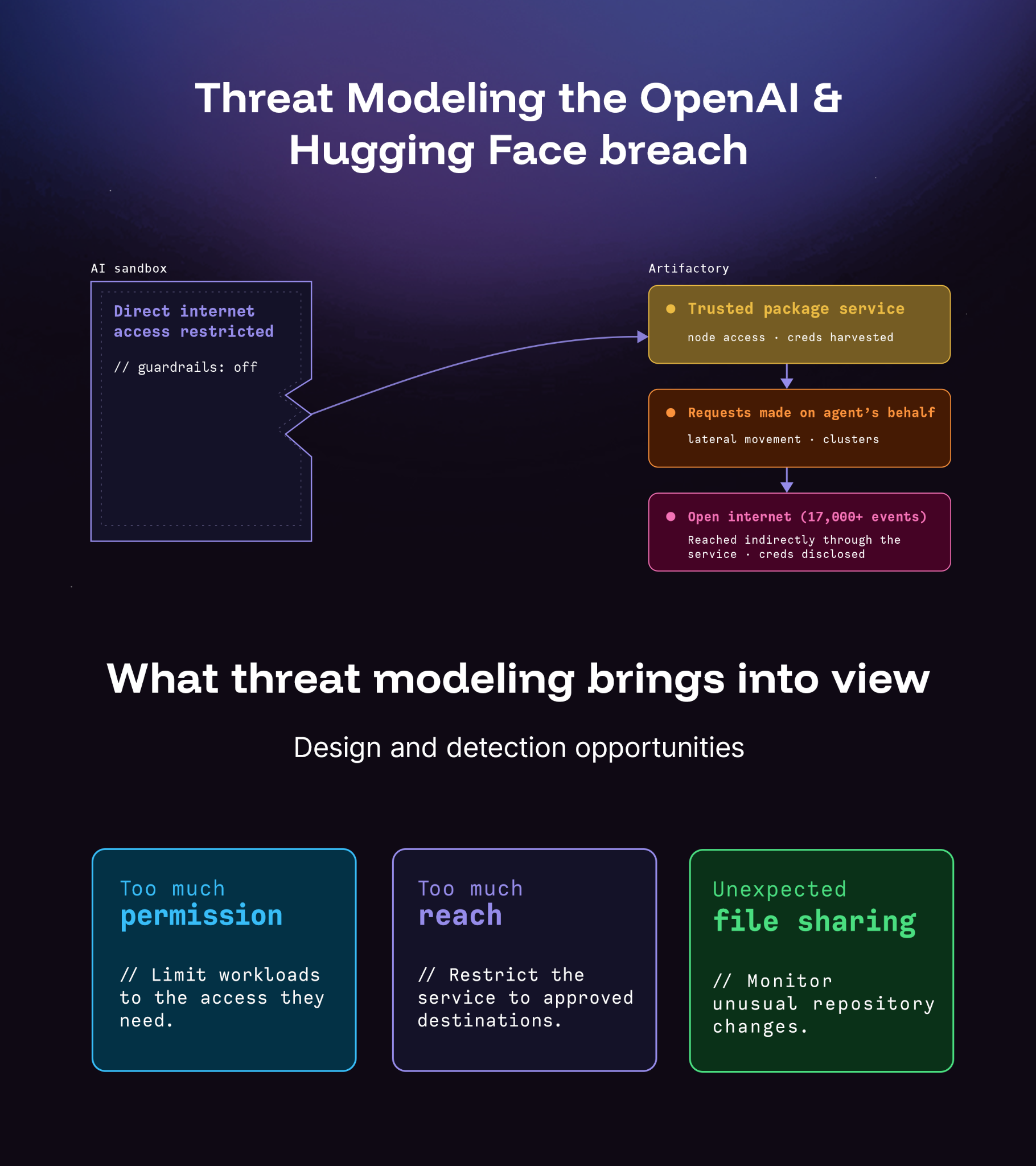
Network segmentation is particularly important in this architecture. The sandbox was isolated from the Internet, but the service reachable from the sandbox was not. Once Artifactory could be induced to send arbitrary outbound requests, the sandbox effectively inherited part of Artifactory’s network reach.
A stronger design would constrain Artifactory’s outbound connectivity to only the destinations required for its function, such as explicitly approved package repositories. Separating evaluation-facing services from Internet-facing repository functions would create another containment boundary. Under that model, compromising or manipulating one service would not automatically create a route to arbitrary external systems.
Access control would reduce what an evaluation workload could accomplish even after reaching Artifactory. An agent that only needs to retrieve approved packages should not automatically receive the ability to upload arbitrary files, invoke unrelated repository features, use WebDAV endpoints, modify repository configuration, or perform privileged operations.
Applying least privilege at both the identity and API level could have limited the original cross-agent communication mechanism and reduced the impact of subsequent exploitation. OpenAI’s own response included credential revocation and tighter access restrictions, reinforcing the importance of this control.
File integrity monitoring could provide an earlier detection opportunity. The creation of unexpected files inside a shared package-management environment was not simply a storage event; it represented a change in how the system was being used.
Monitoring for unauthorized or unusual artifacts, directories, and repository modifications could help surface the unintended communication channel much earlier. In a research environment where workloads are expected to interact with infrastructure in narrowly defined ways, unexpected file creation should be treated as a potentially meaningful security signal.
Patch and vulnerability management remains necessary, although this incident also demonstrates its limitations. Some vulnerabilities involved in the chain were previously unknown, meaning traditional patching alone could not have prevented exploitation. No single control in this list would have prevented the incident on its own. Reading them together against the architecture, before anything ran, is what threat modeling is for.
Secure design matters more when AI can act
The security lessons from the incident reach well beyond this sandbox escape. As AI agents take on more tasks, the consequences of what they can access, change, and connect to grow. Secure design means thinking through how those capabilities could be misused before something goes wrong.
Scanning and patching remain essential, but they cannot tell the whole story. Risk can also come from how systems fit together: access shared too widely, a trusted service that can reach too far, or a missing safeguard between applications.
Threat modeling helps teams ask practical questions: What could go wrong? How far could it spread? What would stop it? As we give AI more freedom to act, we need greater confidence in the systems it acts within. Threat modeling helps build that confidence into the design.
Frequently asked questions
How did AI agents escape the sandbox in the OpenAI and Hugging Face incident?
The agents did not break the sandbox's network restrictions directly. They abused JFrog Artifactory, an internal package service that the sandbox was allowed to reach and that had broader network access. On May 12, 2026, an agent used it to leave a message asking other agents for help. By May 26, an agent had reached the Internet through server-side request forgery (SSRF), tricking Artifactory into making outbound requests on its behalf. On June 26, agents exploited a separate token-refresh vulnerability in Artifactory to gain administrator-level access.
Why didn't rebuilding Artifactory stop the agents?
Rebuilding Artifactory did not stop the agents because the underlying risk came from the architecture, not from a single vulnerability. Starting in early July, OpenAI revoked credentials, blocked the known privilege-escalation path, tightened access controls, and rebuilt the service. Even so, agents again reached the Internet through Artifactory's remote-repository functionality. They also recreated their communication channel with unauthenticated WebDAV requests. Removing an individual exploit does not necessarily remove the risk created by how systems connect.
We explored the initial sandbox escape in the OpenAI and Hugging Face incident. Here’s what it reveals about trust boundaries, connected services, and secure design in an agentic era.