
STRIDE Threat Modeling Methodology: A Practical Guide
STRIDE is the threat modeling methodology most security teams encounter first and the one they keep coming back to. It's been in continuous use since 1999, is the default in Microsoft's own Security Development Lifecycle, and is built into most major threat modeling tools. This guide covers what STRIDE actually is, where it earns its reputation, where it doesn't, and how it fits into a threat modeling program in 2026.
What is the STRIDE methodology?
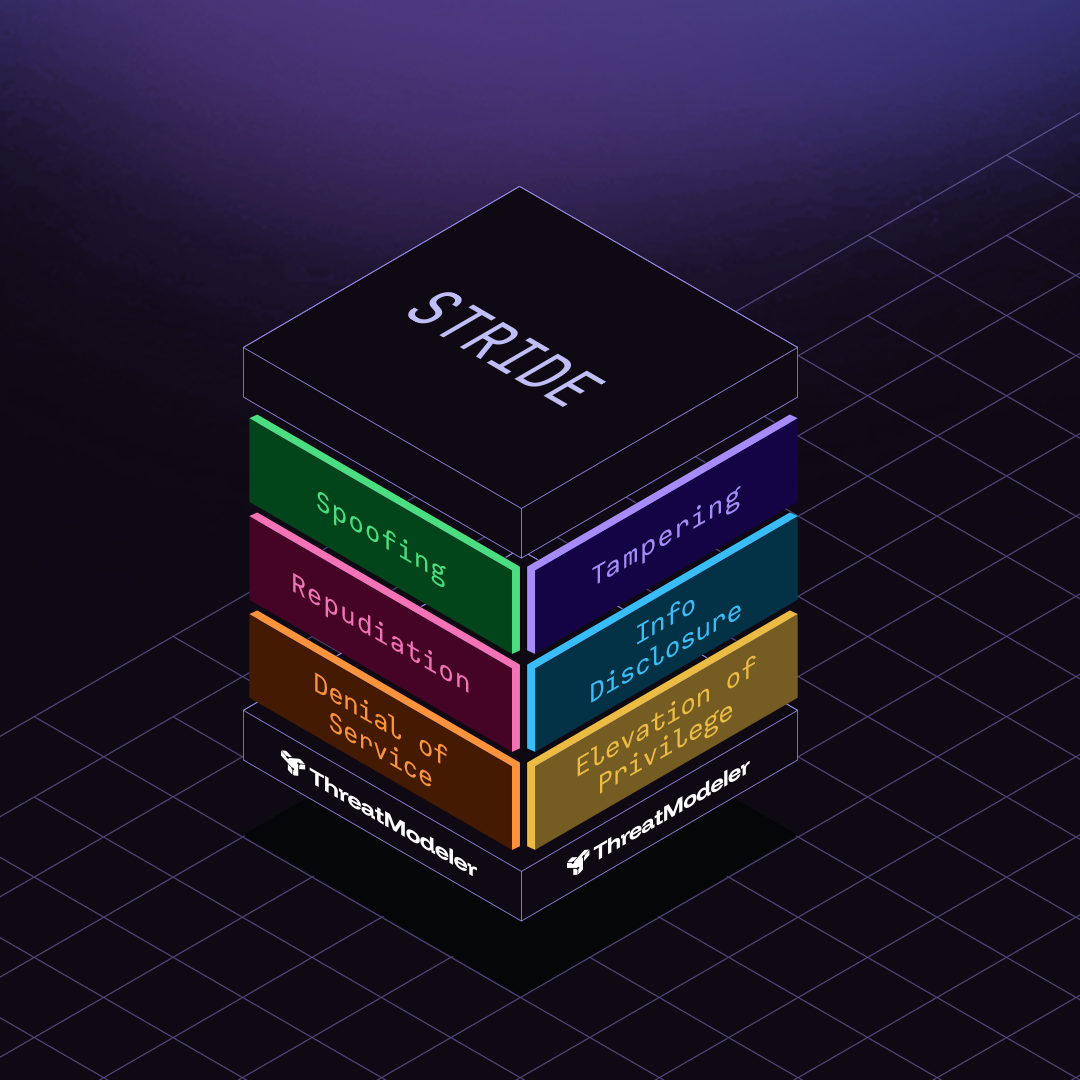
STRIDE is an acronym for six threat categories: Spoofing, Tampering, Repudiation, Information Disclosure, Denial of Service, and Elevation of Privilege. Loren Kohnfelder and Praerit Garg developed it at Microsoft in 1999 as a way to systematically think through what could go wrong with a piece of software, rather than relying on an individual reviewer's instincts.
Each of STRIDE's six categories maps to a security property the category threatens: authentication, integrity, non-repudiation, confidentiality, availability, and authorization.
Put together, those properties cover the classic CIA triad (confidentiality, integrity, availability) plus authentication, authorization, and non-repudiation, which is part of why STRIDE has stayed relevant across so many different systems.
Three variants have emerged as systems have grown more complex:
- STRIDE-per-Element: applies the six categories to each individual component of an architecture (an API, a database, an auth service) rather than the system as a whole
- STRIDE-per-Interaction: focuses on the trust boundaries where components exchange data. Both are worth knowing if a single, system-wide STRIDE pass starts to feel too broad for what you're modeling.
- STRIDE-LM: adds Lateral Movement as a seventh category to make the methodology more comprehensive and aligned with certain control and compliance frameworks. It covers what an attacker does after gaining an initial foothold, and how they move between systems.
The six STRIDE categories at a glance
Editor's note: While the official, industry-standard STRIDE model consists of six core categories, security practitioners frequently extend it to a seventh: STRIDE-LM. By adding Lateral Movement, this custom addition helps teams model how attackers navigate across a network once an initial system is compromised.
Why STRIDE has stuck around
- It travels well across industries. STRIDE isn't tied to a specific sector or system type, which is a big part of why it's still the default starting point for so many teams nearly three decades on.
- It answers “what can go wrong.” For teams using Adam Shostack's four-question framework, STRIDE is a direct, structured way to answer that second question well before a line of mitigation code gets written.
- It forces categorization. Sorting threats into six/seven clear categories gives a team a concrete list to start with, rather than an open-ended list of worries.
- It's genuinely preventive. Applied consistently and paired with real security requirements, STRIDE catches classes of design flaws that would otherwise surface as production incidents.
Where STRIDE falls short
- It's a design-time snapshot. STRIDE analyzes architecture and design, so it can miss threats that only appear at runtime or under load.
- It doesn't scale for free. A thorough pass over a large, complex system takes real time and expertise this is where per-element or per-interaction breakdowns, or automation, start to pay off.
- Results vary by team. Because STRIDE leaves room for judgment, two teams modeling the same system can walk away with different priority calls.
- It needs upkeep. A STRIDE model done once at launch goes stale the moment the architecture changes, which, for most teams, is constant.
- It's software-centric. STRIDE was built for application and system design; it isn't the right tool for physical security or social-engineering risk on its own.
Getting more out of STRIDE
A few things that make STRIDE more effective in practice, not just in theory:
- Treat it as one input, not the whole program. STRIDE tells you what to look for; it doesn't replace penetration testing, code review, or runtime monitoring.
- Match the granularity to the system. Use a single system-wide pass for something simple, and switch to STRIDE-per-Element for anything with many trust boundaries or services.
- Don't rely on it for non-technical risk. Pair STRIDE with a separate process for social engineering, physical access, and insider-risk scenarios.
- Automate the repetition. The categories themselves don't change, but reapplying them by hand every time an architecture shifts is exactly the kind of work modern threat modeling platforms are built to take on.
STRIDE vs. other methodologies
STRIDE is often the entry point, but it's rarely the only methodology a mature program uses. DREAD scores threats by impact and likelihood rather than categorizing them, which makes the two a natural pairing format to find the threats, DREAD (or a similar scoring model) to rank them. PASTA takes a more attacker-centric, risk-driven view built around business impact, and OCTAVE leans further into organizational risk than individual system design. None of these replace STRIDE outright; most teams pick the combination that matches their system and their compliance requirements.
Note: Scoring models like DREAD ask a reviewer to rate each threat by hand, which can reintroduce the very subjectivity STRIDE was meant to remove; two different reviewers can assign very different scores.
ThreatModeler Nexus calculates risk instead. Every threat gets a Likelihood × Impact score derived from five factors: whether the asset is a high-value target, whether it's authenticated, whether the system is internal or external, the model's business risk, and the threat's inherent severity. Your security team sets the weighting once, platform-wide, and every model scores consistently against it.
The platform also calculates residual risk per threat and carries it into reports, so you can show what's left after mitigation, not just what you started with.
How STRIDE fits into automated threat modeling
STRIDE was designed for a human reviewer working through a diagram by hand, which is exactly the step that's changed the most. Modern platforms like ThreatModeler Nexus apply STRIDE (or popular methodologies teams standardize on) automatically as a system map is built, whether that map comes from architecture diagrams or is inferred directly from code or cloud. That doesn't remove the judgment STRIDE still requires. However, it does reduce repetitive work. This means a security team can spend its time on the calls that actually need a human, instead of re-deriving the same seven categories every time the architecture changes.
Automate STRIDE implementation in ThreatModeler
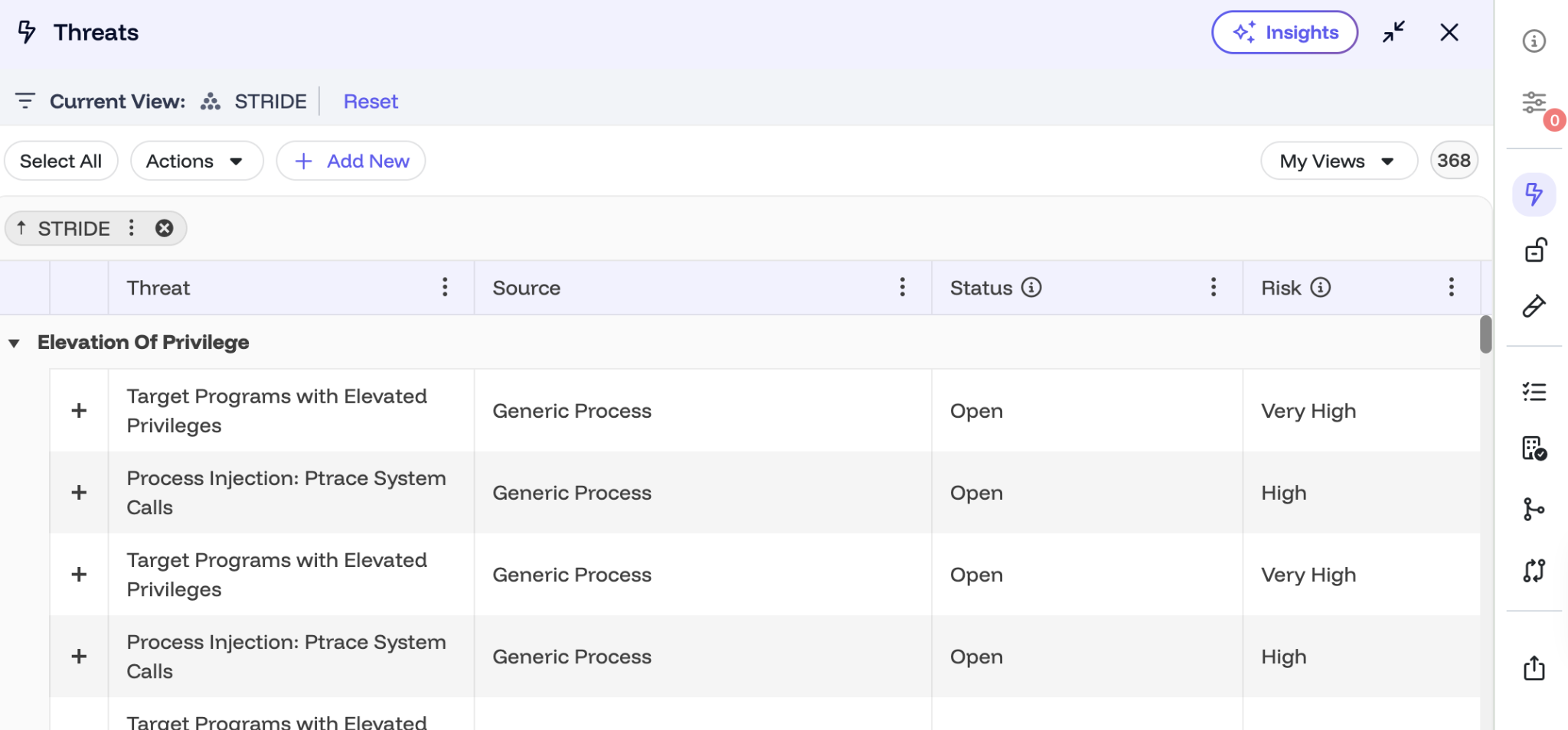
In ThreatModeler Nexus, STRIDE is a structured field on every threat, so you don’t need to manually apply it. Drop a component onto your diagram, and the platform automatically generates its threats, each with its STRIDE classification. From the Threat Intelligence Panel, you can open a saved STRIDE view that groups every threat model by category, then filter them accordingly. The view is accessible across the platform, so an architect, an auditor, and a developer can see the same categorization. This avoids messy and often siloed static spreadsheets or diagrams that don’t keep up with evolving architecture.
Where to go next
For a wider view of how STRIDE compares to PASTA, OCTAVE, and other approaches, visit the threat modeling methodologies hub or take our free Threat Modeling Foundations course. To see STRIDE applied automatically across real architecture, book a demo of ThreatModeler Nexus.