The Model Context Protocol (MCP) has rapidly become a strategic linchpin in the AI ecosystem, providing the standard for connecting local data sources to remote Large Language Models (LLMs) The Anthropic MCP Incident has recently highlighted how risks identified in a major protocol like MCP have potentially impacted over 150 million downloads, according to current reporting. Yet the broader systemic risk of AI has already become our new reality.
As organisations continue to integrate Large Language Models (LLMs) and autonomous agents into their core infrastructure, the attack surface has fundamentally transitioned from discrete code vulnerabilities to complex architectural logic flaws. Traditional reactive security measures such as post-production vulnerability scanning, are inherently insufficient for these dynamic environments; they lack the context to identify the subtle exploit chains inherent in modern AI architectures.
The core nature of a MCP vulnerability is architectural. Because it introduces a significant architectural bridge across trust boundaries and facilitates data flow between secure local environments and remote SaaS models, any flaw in the protocol can lead to unauthorised data exfiltration or tool compromise.
Indeed the systemic risk is profound: an inherited vulnerability in a third-party protocol can bypass traditional perimeter defenses. Preventing such massive exposure requires a fundamental strategic shift. Architectural visibility is no longer optional, it is the prerequisite for governance.
MCP risks are just one instance in a general class of threats that arise when AI agents interact with protocols that manage their internal context or memory through such protocols. When organisations adopt third-party AI services and open-source protocols, they are not just consuming a service, they are fundamentally extending their attack surface into a potentially unmapped supply chain.
Architecting Visibility: Mapping the AI Attack Surface
In complex AI environments where data frequently crosses between local clients and remote models, architectural visibility serves as the primary line of defense. Without a granular map of these interactions, security teams cannot identify where a protocol like MCP creates a bridge into sensitive data stores.
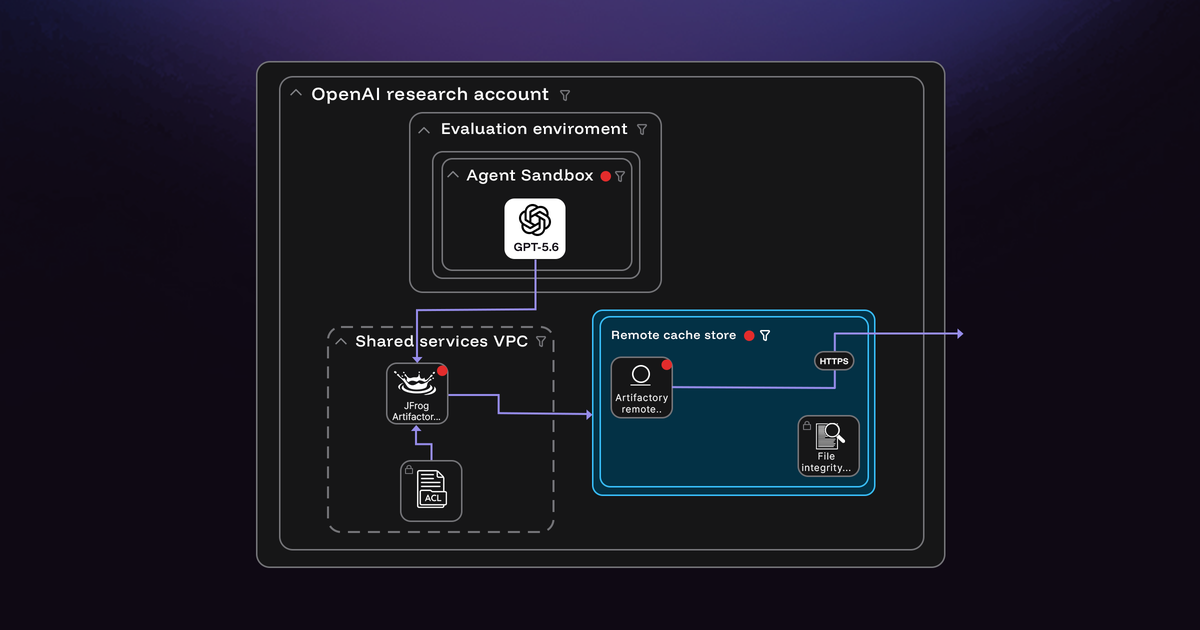
Utilising CloudModeler and intelligent cloud mapping, ThreatModeler enables architects to move beyond manual documentation. By leveraging direct cloud imports from Amazon Web Services (AWS), Microsoft Azure, and Google Cloud Platform (GCP), the platform automatically generates a visual Data Flow Diagram (DFD). This is not a static image but a live representation of the architecture, derived from the real-world cloud corporate and AI infrastructure.
The strategic value of a diagrammatic and intelligent grouping and layout combined with trust Boundaries is critical here. In an MCP-based architecture, ThreatModeler identifies exactly where the local MCP client sits in relation to the remote AI service. By visualising the trust boundary, security professionals can see the precise point where data leaves a secure internal VPC for a third-party environment. Visibility is the essential foundation for systematic threat identification.
Targeted Intelligence: Adopting a holistic, compliance-led approach through AI-Specific Threat Libraries
Generic security checklists fail to capture the nuances of agentic AI. Protecting against AI supply chain risks requires specialised intelligence that understands the unique failure modalities of LLMs. Strategic defense mandates the use of specialised frameworks, such as MITRE ATLAS, OWASP Top 10 for LLM, and ISO 42001 v2023, to address the specific risks of agentic tool compromise.
ThreatModeler’s Intelligent Threat Engine (ITE) supports Advanced AI-specific threats, flagging vulnerabilities at the design stage. In an agentic context, tool compromise is particularly dangerous, as it could grant an AI agent unauthorized write-access to a production database through a flawed MCP connection.
The following table maps potential MCP-related threats to ThreatModeler’s intelligence and AI specific industry frameworks and sources and provides examples of mitigation strategies derived from the platform’s expertly curated knowledge base:
Potential AI / MCP RiskFramework\ComplianceThreat CategoryMitigation ExamplesTool/Function CompromiseOWASP Agentic AI Threats (2025)Agentic AI ExploitationGranular IAM Access Controls; Output SanitisationModel Extraction & EvasionMITRE ATLASAI-Specific Adversarial TacticsRate Limiting; API Request ValidationPrompt InjectionOWASP Top 10 for LLMsInput ManipulationWeb Application Firewall (WAF); Input ValidationData PoisoningCSA Cloud Top ThreatsSupply Chain IntegrityData Integrity Hashing; Trusted Source VerificationProtocol Logic FlawsSTRIDE / VAST / MITRE CAPECArchitectural VulnerabilityMutual TLS (mTLS); Secure Session Management
The Secure by Design Defense: Preventing Vulnerabilities/Threats in the design phase
The strategic imperative of the “Shift-Left” movement is underscored by a critical metric: addressing an architectural flaw during the design phase is significantly more cost-effective than post-production remediation. ThreatModeler achieves this through automated Threat Modeling, accelerated by native pipeline integrations with platforms like cloud platforms, GitHub, GitLab, and Bitbucket. As DevSecOps teams author Infrastructure-as-Code (IaC) templates, including Terraform, AWS CloudFormation, and Azure Resource Manager (ARM), these are automatically modeled in ThreatModeler. Upon identification of a potential threat, the platform provides automated remediation recommendations and Security Control mapping.
Instead of a generic alert, the system suggests specific countermeasures and remedial guidance to address the threat. This ensures that security standards keep pace with high-velocity AI development, preventing the deployment of inherently flawed architectures.
Continuous Governance and Residual Risk Management
In an era where AI dependencies evolve daily, threat modeling must be a continuous process, not a one-time project. Strategic resilience requires a “living document” that reflects the real-time state of the cloud environment.
Through Continuous Updates and Auto-Versioning, CloudModeler leverages automation to preserve the accuracy of the threat model by automatically reflecting changes in the live AWS, Azure, or GCP environments. This is where the strategist utilises the advanced risk calculation features to determine the current risk posture based on the organisation’s unique weighting of likelihood and impact.
Crucially, the platform provides critical insights into residual, and indeed acceptable risk. This allows CISOs to evaluate the effectiveness of applied controls, determining if controls surrounding an MCP integration are truly effective or if gaps remain. By identifying the risks that persist after mitigation, organisations can move toward a high level of risk compliance through informed, data-driven decision-making. This transforms threat modeling into a core component of organisational resilience.
Key Takeaways for Proactive AI Supply Chain Security
The recent vulnerability of protocols like MCP proves that the AI supply chain is a new frontier for systemic risk. To defend this frontier, organisations must adopt an automated, platform-based approach to threat modeling.
- Scalability: Automation as a force Multiplier: CloudModeler eliminates manual diagramming, allowing security teams to scale coverage across thousands of models across AWS, Azure, and GCP simultaneously.
- Specialised AI Intelligence: Utilising MITRE ATLAS and OWASP Agentic AI Threat frameworks ensures that defenses are mapped to modern exploits like compromise and AI model evasion, aligned with ISO 42001 standards.
- Secure by Design & The Shift-Left Mandate: Integrating CloudModeler and Github Integrations into the SDLC for Terraform and CloudFormation ensures that architectural flaws are neutralised as soon as possible, drastically reducing remediation costs.
- Visual Traceability, Auditability and Compliance: Automated DFDs and comprehensive compliance reporting (NIST AI RMF, CSA CCM) provide the documented proof of security required for modern regulatory oversight.
As AI continues to redefine the enterprise, ThreatModeler remains the essential partner for innovation. By providing the architectural foresight and automated defense needed to navigate the AI era, we enable you to lead without inheriting catastrophic risk.
Learn More
If you’d like to understand how ThreatModeler helps teams revisit assumptions, identify critical dependencies, and keep threat models current as conditions change, visit our contact our team to start a conversation.
Frequently asked questions
What is the Model Context Protocol (MCP)?
The Model Context Protocol (MCP) is a standard for connecting local data sources and tools to remote large language models. It has quickly become a key part of the AI ecosystem because it lets AI agents read data and use tools across systems, which also makes it a bridge across trust boundaries.
Why are MCP vulnerabilities an architectural risk?
MCP moves data between secure local environments and remote SaaS models, so it sits across trust boundaries by design. A flaw in the protocol can lead to data exfiltration or tool compromise, and an inherited vulnerability in a third-party protocol can bypass traditional perimeter defenses. Scanning code alone won't reveal that kind of exposure.
What is AI supply chain risk?
AI supply chain risk is the exposure an organization takes on when it adopts third-party AI services, models and open-source protocols. Each one extends the attack surface into a supply chain the team may not have mapped, so a weakness in someone else's component can become a path into your systems.
Which frameworks cover AI and MCP threats?
Useful references include MITRE ATLAS, the OWASP Top 10 for LLM Applications, the OWASP Agentic AI threats and ISO 42001. They cover risks such as prompt injection, data poisoning, model extraction and tool compromise, while STRIDE, VAST and MITRE CAPEC still apply to protocol logic flaws.
How can you secure MCP integrations at the design stage?
Map where the MCP client sits relative to the remote AI service and where data leaves your environment, then model threats against that trust boundary. Typical controls include granular IAM permissions, output sanitization, input validation, mutual TLS and secure session management. Review residual risk regularly, since AI dependencies change often.