One connected model of your system, always current.
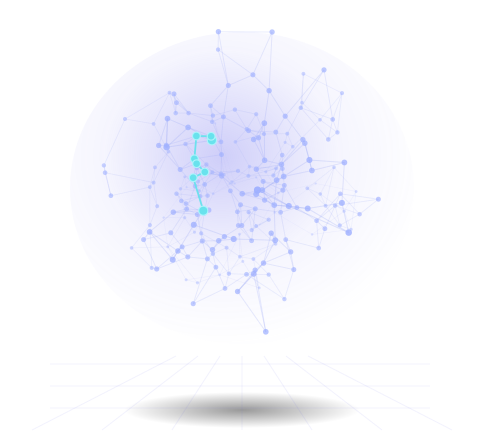
The Graph Agent connects your components, threats, controls, and compliance into the Secure Design Graph, and keeps it current as the system changes. Because it reasons over a graph, it can see what is missing, not only what is there.
What's there is easy to list. What's missing is where risk hides.
Connects everything. Keeps it current.
The Graph Agent connects your components, data flows, trust boundaries, threats, controls, and compliance into a single model you can query.
As architecture drifts and new threats and frameworks arrive, it updates that model, so coverage holds without a manual rebuild.
Explore the Secure Design GraphIt finds what isn't there.
A prompt can only react to what it is handed. It cannot guarantee coverage or flag a control that was never added. That is a limit of the model, not a gap a larger model closes.
The Graph Agent reasons over the connected model, so a missing control or an undefended path is a fact it can find. That is how we find what's missing.
Prioritize what matters, with the whole picture
The Graph Agent brings trusted frameworks and attacker paths together on one model, so teams focus on the risks that count.
Categorized by design
Organize threats by STRIDE, or by whatever methodology your teams already run. The platform stays methodology-agnostic, so categorization is consistent however you work.
Tied to trusted libraries
Findings align to continuously updated libraries, including MITRE ATT&CK, OWASP Top 10, CAPEC, and D3FEND.
See how an attacker moves
Record and replay how an attacker could move through the architecture, annotated with threats and countermeasures.
What remains after controls
See the threats that are still open once controls are applied, so teams prioritize the real gaps.
Clear priorities, grounded
AI summaries turn complex threats into plain priorities, every one tied back to the model.
Tailored to your org
Add custom threats and requirements, then promote them to the shared library for everyone.
Three agents on one Graph
Each agent has a job. Together they build the model, keep it current, and turn it into proof.
System Mapping Agent
Reads your architecture, code, cloud, and documents and builds the model, creating what it needs along the way.
Explore the agentGraph Agent
Connects components, threats, controls, and compliance in the Graph, and keeps it current as the system changes.
You are hereReporting Agent
Turns the Graph into audit-ready findings, control recommendations, and compliance reports on demand.
Explore the agent